Questions
This page answers common questions about the units, sites, costs and risks. Figures are company targets until field trials confirm them.
The units
Do the units harm sea life?
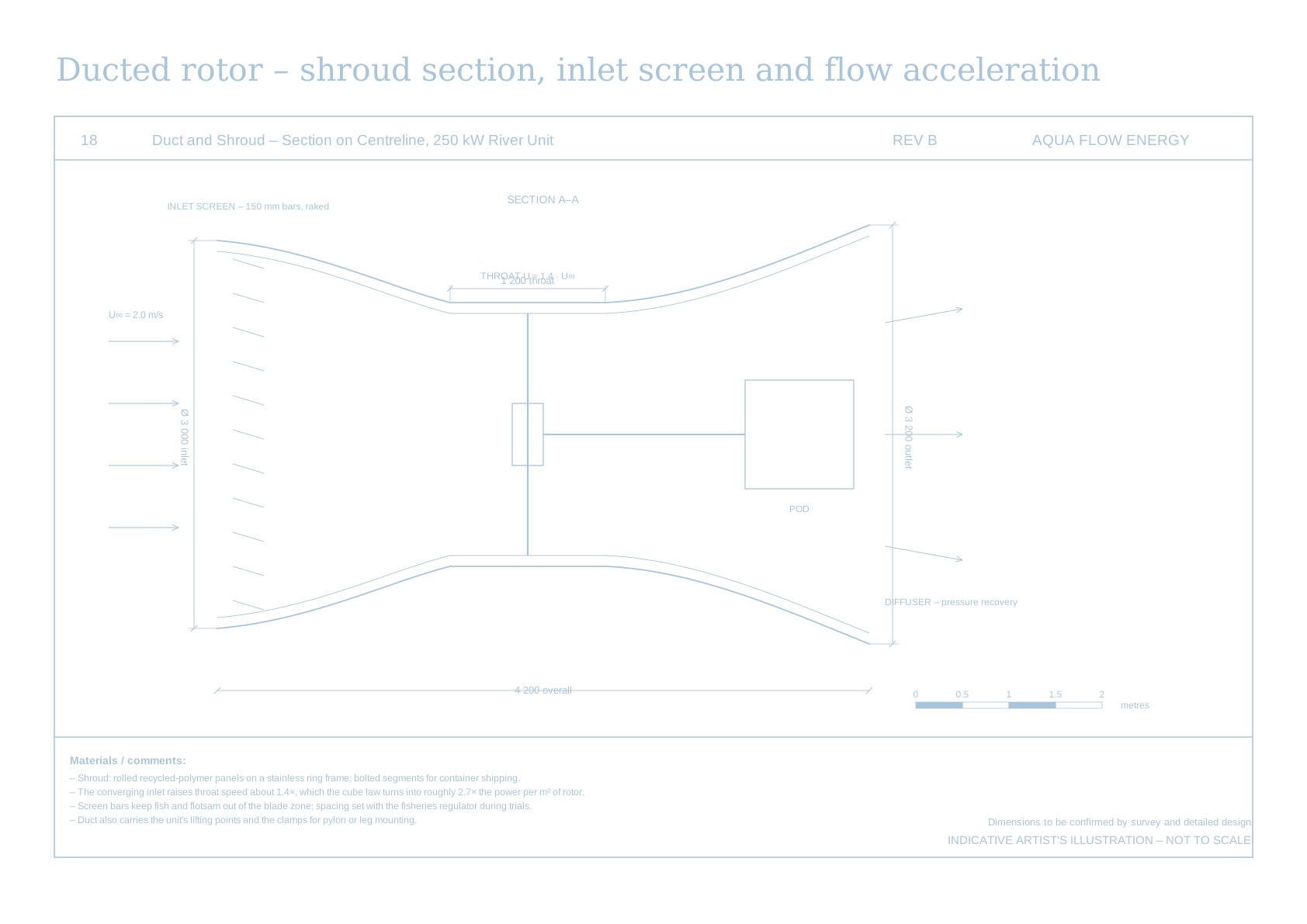
The designs aim to avoid it. Spiral blades turn slowly with open space between them. Faster units sit behind screens and ducts that keep fish out. We will measure the effect on fish and marine mammals in field trials.
Does the technology need much development?
The generators and drivetrains are commercial parts you can buy today. Our development work is the blade shape, matched to each range of water speeds. Full-scale prototypes and lab tests are the next step.
How big are the units?
Units are 2 to 10 metres across, depending on the power needed and the water speed at the site. There are six capacities, from 50 kW to 2 MW.
Can they be exported?
Yes. They fit ISO shipping containers and can be assembled on site in about four hours.
Will mass production be hard to set up?
No. A standard assembly line is enough, and the parts and skills are available worldwide. Early units can be built in any fabrication workshop.
How often do they need maintenance?
Every six months. The generator pod is lifted out and replaced, and the used pod is serviced on land.
Sites
What kinds of locations?
Units suit bay entrances, high-tide coasts, ocean currents, offshore wind towers, river banks and walkways, bridges, and irrigation and water supply pipes. The best sites are where water infrastructure meets existing power lines.
How do you measure a site?
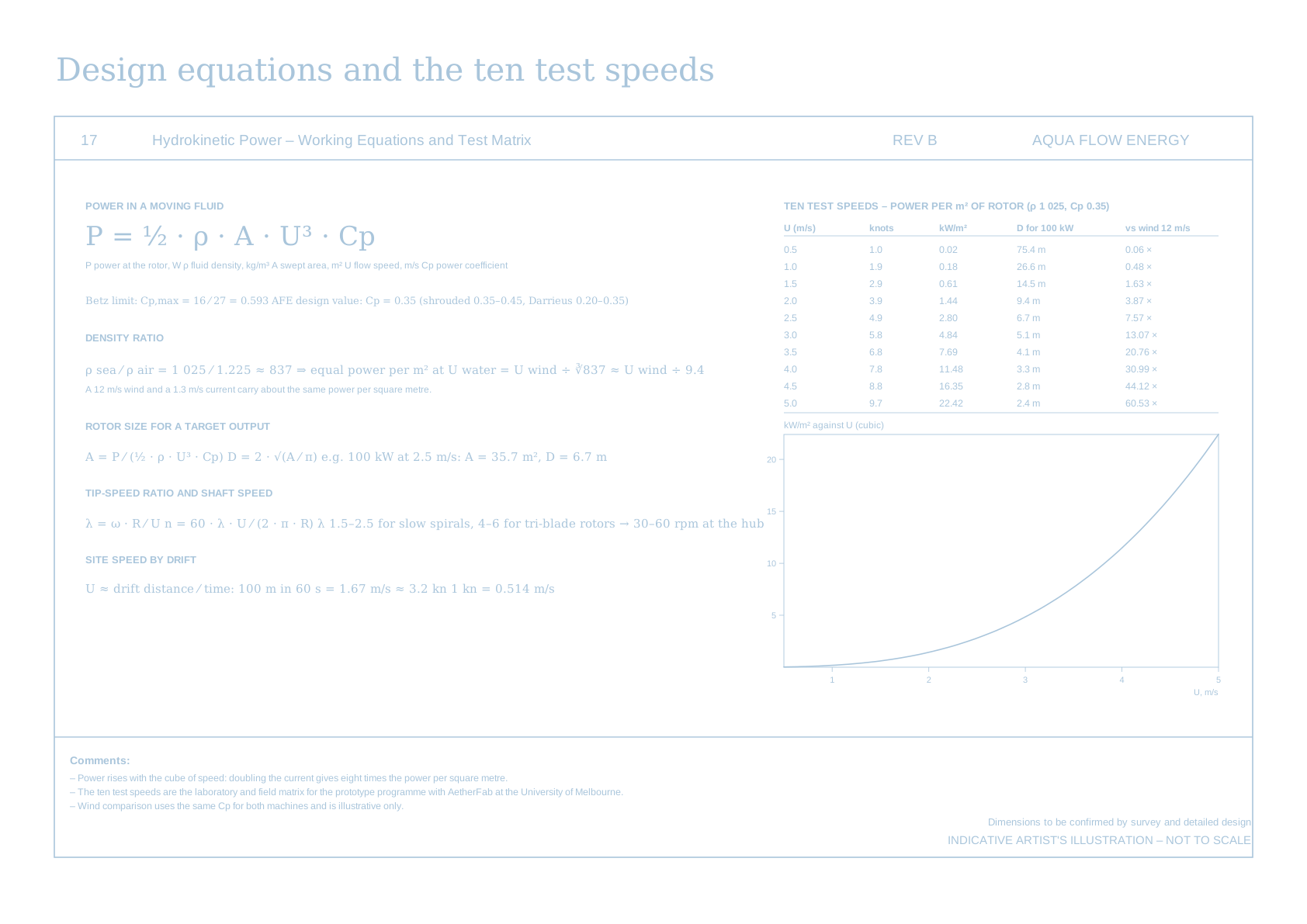
By boat in calm weather. A buoy dropped off the stern at anchor shows the direction, and tracking the boat's drift by GPS gives the speed. A hundred metres in sixty seconds is 1.7 metres a second, about 3.3 knots, a common tidal speed and one we prefer.
Can you see them?
No. At most sites the units run fully below the surface. In rivers they hang under walkways and bridges.
Will they get in the way of boats?
They sit below the surface and are placed clear of shipping lanes.
Can they be close to cities?
Yes. Most cities are on the coast or a river. Making power close to users means fewer new transmission lines.
How much space does an array need?
Far less than solar or wind with the same output, because moving water carries more energy per square metre. Exact spacing depends on water speed and depth and will be set during trials. In a river, units can sit every three to four metres along a bridge or walkway.
Cost and output
How reliable is the power?
Rivers, ocean currents and water pipes flow all day. A tidal site flows for about 20 hours in 24, with a short pause each time the tide turns. Units at several tidal sites along a coast cover each other's pauses, so an array can supply power around the clock. That is two to four times the running hours of wind or solar.
What does a unit cost?
Small units sell at list: US$350,000 to 400,000 for 50 kW, US$450,000 to 500,000 for 100 kW and US$800,000 for 250 kW, each with a yearly service fee. Over ten years that is half or less of the diesel they replace.
Data centres and cities buy 500 kW and 1 MW units at US$5.0 million per megawatt for the first 50 MW, stepping down to US$3.5 million per megawatt after 200 MW. The planning build cost of a 1 MW unit is about US$1.21 million.
Will the electricity be expensive?
Leased power is priced under the buyer’s next cheapest firm option: US$100 per megawatt hour to cities and data centres, against on-site gas engines at about US$107, and US$150 to islands, against diesel power at about US$300. The supply runs day and night without batteries. Field trials will test these prices.
Who else is doing this?
Tidal power is proven. La Rance in France has run since 1966. Most current designs are large machines that need fast water. Their many moving parts make them costly to build and maintain. AFE builds small units from stock parts that work in slower water.
Main risks
Field performance
Output is modelled and has not yet been measured at full scale. This round pays for the prototypes and field trials that will measure it.
Fouling and corrosion
Units use anti-fouling coatings and polymer and composite parts that do not rust. Pods are swapped every six months.
Storms and debris
A shroud around the rotor and guides upstream push debris away.
Environmental approval
Fish safety is part of the design from the start, which should shorten permitting. Trial data will support each application.
Manufacturing partners
The licensing model depends on signing assembly and maintenance partners in each region.
Capital at risk
Early-stage technology can fail. Investors could lose all the money they put in.